The year 2013 was a year of positive professional transition for me, but it was a bit of a bust when it came to running. The year started off a bit rocky, but I pulled things together enough to have a solid race at the Vermont City Marathon on Memorial Day weekend. I managed to put in solid miles through July, but then the reality of my need to wrap up loose ends from the old job and get things rolling with my new career hit hard. My running suffered, and my mileage in August and September was so lousy that I bailed on running the Vermont 50K. Things didn’t get much better into the Fall – there was just too much going on (things have settled a bit, just did a 30 mile week at the end of December!).
As a result of the transition I went through in 2013, I didn’t get to put decent mileage on as many shoes as I would have liked, but there are a few that have stuck out. Below are 5 road shoes that made an impression on me in 2013.
1. New Balance Men's M1400
I was wary of trying the New Balance Men's M1400 since it has a higher drop than I usually prefer (9mm HTF), but rave reviews from friends forced me to break down and buy a pair. I was not disappointed! Soft heel, firm forefoot, and super light. And, the price is reasonable – they can typically be found for under $90. I’d rank them as my top shoe of the year due to the combo of performance and affordability.
Read : New Balance Men's M1400 Reviews : Check best price
2. Adidas AdiZero Adios 2
The Adidas AdiZero Adios 2 is another shoe that I was skeptical of due to a higher than preferred drop, but like the NB 1400v2 it worked just fine for me. It also features a soft sole, firm, responsive forefoot, and glove-like fit. The Boost midsole material is bouncy under the heel, and retains its cushioning properties in sub-freezing temps, which is a huge plus for the shoe. The only negative on this one is price – at $140 it’s a much more expensive shoe than the similarly performing 1400v2, and I’m not sure if durability is that much better to warrant the higher price tag.
Read : Adidas Adidas AdiZero Adios 2 Reviews : Check best price
3. Newton Energy Mens
I put a bunch of miles on the Newton Energy this past summer and enjoyed all of them. Like the two shoes above, the Energy has a soft heel and a firm forefoot (notice a pattern here?). The Energy also features the new 5-lug pattern under the forefoot, which makes this shoe more stable mediolaterally than 4-lug Newton shoes. One caveat on the Energy – the heel fit out of the box is sloppy due to the sockliner/insole being too thick. Either remove or swap out the sockliner for a thinner one and the shoe becomes a beauty!
Read : Newton Energy Mens Reviews : Check best price
4. Saucony Men's Virrata
The Saucony Men's Virrata was my Spring marathon shoe and it performed well. Great cushioning for a zero drop shoe, particularly under the forefoot. This is one of the few zero drop shoes on the market that I would choose for a marathon length race, and the Virrata price tag is also reasonable at $89.99 MSRP. One Virrata caveat – the shoe fits a bit narrow in the forefoot, but going a half size up solved this for me.
Read : Saucony Men's Virrata Reviews : Check best price
5. Pearl iZUMi Men's E:Motion Road N 1
This was a tough choice. I’m going with the Pearl Izumi EM Road N1 at #5 because it’s a very different shoe than the others on this list, and I was surprised by how much I liked it. Unlike the other 4 shoes here, the PI N1 is a very firm shoe, but it rides very smooth. It’s a shoe that I wasn’t crazy about the first time I took it out, but it grew on me with each subsequent run. The upper is awesome – stretchy and accommodating, and the unusual sole architecture is reminiscent of the Skechers GoRun (the GoRun 2 was one of my top 5 last year). Very impressed with this one! Read my full Pearl Izumi EM Road N1 review here.
Read : Pearl iZUMi Men's E:Motion Road N 1 Reviews : Check best price
Honorable mentions among road shoes: Nike Free 3.0 v5, Mizuno Universe 5, Mizuno Cursoris, Asics Gel Lyte33 v2 (note since I’m sure I’ll be asked: I didn’t include the Skechers GoRun 3 since it came out late in the year and I have not reviewed it yet, it’ll be a candidate for 2014)
A few weeks ago I wrote a post about how to keep man-parts warm on runs in the winter. The response to that post was incredible (now nearing 15,000 hits!), so clearly it was a topic of interest to runners, especially considering how cold this winter has been in many parts of the world (one of the coldest I can remember).
Earlier today I got a message from a fellow New Englander asking about how I keep my hands warm on winter runs, so I thought another post on the topic of keeping warm on winter runs might be helpful. Here goes!
Keeping Hands Warm
I used to have a lot of problems with my hands freezing on cold winter runs. Then I discovered running mittens. Problem solved.
For the longest time I had only ever used gloves, and when it got really cold out they just weren’t cutting it. My fingers would get frigid to the point of hurting, and this discomfort added to the list of reasons my brain would confront me with in an attempt to keep me from running outside in sub-freezing temperatures. My brain never won though since my hatred of the treadmill is greater than my fear of cold fingers.
I don’t recall if it was last winter or two winters ago, but I was in the Fleet
Feet store in West Hartford, CT (my hometown) and I saw a pair of Saucony Run Mitts on the wall. I’d never tried running with mittens, so I figured what the heck – they weren’t terribly expensive, why not give them a try?
There’s nothing particularly fancy about the Saucony Mitts – just a layer of windbreaker type material on the outside and a softer layer of knit material on the inside. They aren’t particularly thick either, and other brands seem to have comparable options (if you have a favorite, leave a comment). But man do they work!
If you’ve never used mittens for cold-weather running, I highly recommend that you try them. I ran seven miles earlier today, it was about 20 degrees F outside and breezy (downright balmy compared to the past few days!), and with the mittens my hands were sweating within a few miles into the run. By keeping your fingers in contact within a single, enclosed compartment, the body heat generated keeps things nice and toasty. And if your thumb starts to get cold, you can just pull it into the mitten and make a fist to warm everything right up. Mittens are so effective for me that I typically only wear them when it’s below freezing out, otherwise my hands get way too hot. If it’s above 30 degrees F or so I opt for thin gloves.
I would like to make one distinction – I also have a pair of mittens where the fingers stick out and a mitten flap can be wrapped over them when desired. I don’t find this design to be nearly as effective as a standard mitten where everything is fully enclosed in one big space. Keeping skin-skin contact between the fingers seems to be the key.
Keeping Feet Warm
I personally have never had a problem with cold feet on runs. My feet might be chilled for the first 5 minutes or so after leaving the house, but once I’m a half mile to a mile into the run they warm right up. It’s all about blood flow I think – once I start moving and blood starts circulating faster, my feet are fine. I actually don’t tend to wear thick socks on runs in the winter for this reason. I find that thick socks make for a tighter fit inside my shoes, and I think this impedes blood flow to my feet. My tactic instead is to wear thin socks and to make sure my shoes are not laced too tight. Let the blood flow as easily down through the skin of my feet as possible. This approach has never failed me.
A quick note on socks. I do like to wear thicker socks around the house and with casual shoes. I love the thicker Injinji trail socks (all Injinji socks really), but they don’t work well for me in extreme cold for the same reason gloves don’t work for my fingers – skin to skin contact is key for warmth. I also like double-layered Wrightsocks for blister protection, and I was recently sent several pairs of DeFeet Merino wool socks that are nice. But, and I’m somewhat ashamed to admit this, the majority of the time when I run (year round) I wear Champion C9 socks from Target. They come in packs of three pairs for just over $9.00, and I have yet to wear a pair out. They’re really thin, but they seem to last forever. Wore them today for seven miles in the cold and had no issues at all.
runblogger.com
BY ALL MEANS, SIZE UP!
While your pant size may drop, your shoe size won't. Many runners find the best fit comes from going up at least a half size for a little extra room in the toe box. In fact, Dr. Hecker noted that many people are wearing shoes 1 and a half; sizes too small for their feet. Aim for a thumb's width between your longest toe and the end of the shoe. Remember that your foot will expand when running. Sizing up will help you avoid black, and soon-to-be missing, toenails.
CHANGE SHOES EVERY 4-5 MONTHS
Be afraid of commitment — running shoes are not meant to last. One of the worst things you can do is to wear worn-out shoes. If you start experiencing aches and pains, it's time for a new pair. "Many injuries occur because a runner continued to wear a shoe after it had broken down", says Dr. Hecker. "Most injuries can be remedied with a simple change of shoe". Running shoes are designed to handle about 500 miles or last about 4-5 months on average. According to Dr. Hecker, the higher your arch, the faster you'll wear out your shoes.
ROTATE SHOES
Go ahead, mix it up! A lot of runners choose to rotate several pairs of running shoes at the same time, even if they're the same make and model. This helps avoid excessive wearing in any particular area and avoids irritation.
SOCKS MATTER
Boy, do they. Moisture-wicking and thermo-regulating performance socks are best for running. Cotton socks can cause blisters (not to mention swamp foot) because they don't breathe well or effectively remove moisture.
DON'T JUDGE A SHOE BY ITS COVER
Never choose a pair of running shoes based on looks alone. You won't care what color they are if your feet hurt.
GO MESH
Look for a running shoe with a mesh upper. Mesh breathes well and provides necessary ventilation. And like good socks, mesh also helps prevent odors that could clear a room.
INVEST IN QUALITY
A trip to the doctor or physical therapist will end up costing you more (in money and discomfort) than you might have saved on an inferior pair of shoes. Put your trust in a proven brand name.
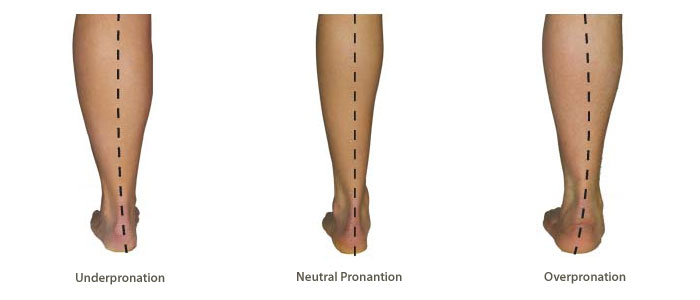
Pronation is the term used to describe the normal motion of the foot rolling slightly inward through the foot strike. Pronation is essential to shock absorption and forward propulsion. It's when you overpronate or underpronate (supinate) that you need to be particular about the running shoe you choose.
WHAT KIND OF PRONATOR ARE YOU?
The arch of your foot plays a major role in pronation. The three different arch types, normal, flat, and high, correspond to the degree of pronation you're most likely to experience. You can get a good idea of your arch type by completing the Wet Foot Test below.
Determining Your Arch Type: Wet Foot Test
Dr. Hecker recommended the Wet Foot Test to help you determine your arch type. Just follow the steps below - it couldn't be easier.
Wet the bottom of your foot
- Step onto concrete, a paper towel or any surface that will show an imprint of your foot
- Match imprint to one of the arch types below to determine your degree of pronation
- Note: Another way to determine arch type is to look at the outsoles of your old running shoes, although this method is less reliable than the Wet Foot Test. If the sole is worn equally on both sides, you most likely have a normal arch. If you have a flat arch, the sole will show excessive wear on the inside. A high arch usually produces a sole with noticeable wear on the outside.
Quick Tip: You cannot determine arch type by looking at the wear pattern on the heel alone, although this is a common misconception.
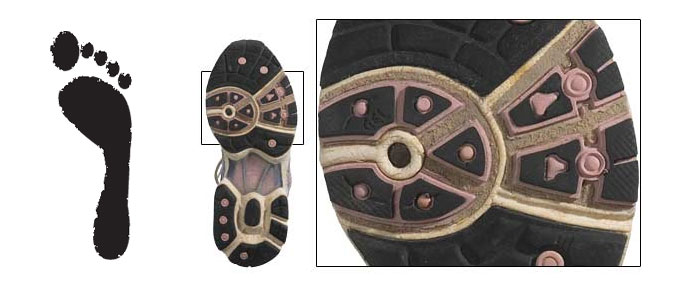
Normal Arch = Neutral Pronation
Notice the wear pattern is uniform and centered closer to the middle of the sole. The textured rubber is still present on both sides of the sole.
The most common arch type, the normal arch, leaves a wet print with a flare and a broad band connecting the heel and the forefoot. This foot type is a neutral pronator and rolls inward slightly to absorb shock. If you have a normal arch, you're considered bio-mechanically efficient and don't need motion control features. The best part about having a normal arch is that you have more freedom when picking a running shoe.
Quick Tip: If you have a normal arch, the sole of your old running shoe will be worn equally on both sides.
THE SHOE FOR YOU
Cushion shoes are the most flexible and encourage natural pronation, with added cushioning and extra shock absorption. These shoes do not have stability or motion control features. Or, Stability shoes have light support features on the medial side and well-cushioned midsoles to help guide mild-to-moderate overpronation. Runners with a normal arch can also benefit from light stability features.
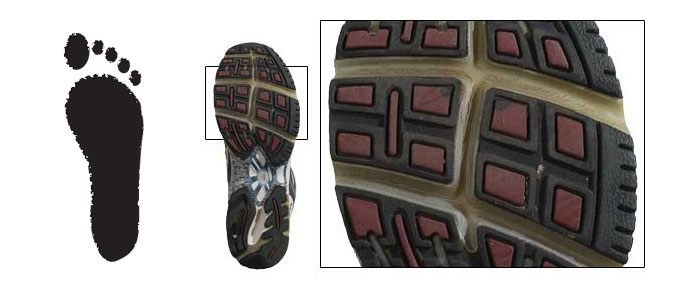
Flat Arch = Overpronation
Notice the increased wear and lack of texture on the medial side (inside) as compared to the lateral side (outside), which still has the texture intact.
If you see a complete or nearly complete imprint, then you have a Flat Arch. This type of foot is associated with overpronation, or an excessive inward roll after heel strike. The flatter the arch, the more support and motion control you need. You'll need shoes with firm midsoles, flatter soles and pronation-control features. Steer clear of highly-cushioned shoes that lack stability features.
Quick Tip: If you have a flat arch, the sole of your old running shoe will most likely show excessive wear on the inside.
THE SHOE FOR YOU
Stability shoes have light support features on the medial side and well-cushioned midsoles to help guide mild-to-moderate overpronation. Or, Motion Control shoes incorporate extra stability features on the medial side to help control severe overpronation. Runners with a severely flat arch are well suited for these types of shoes.
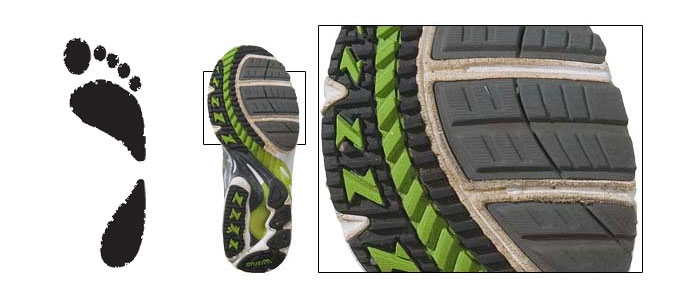
High Arch = Underpronation (Supination)
Notice the increased wear on the lateral side (outside) while the medial side (inside) is relatively untouched.
The least common arch type, the High Arch, will produce an imprint showing the heel and forefoot connected by only a thin band. This foot type usually doesn't absorb shock well because it rolls outward or underpronates (also known as supinating).
Quick Tip: If you have a High Arch, the sole of your old running shoe should show excessive wear on the outside.
THE SHOE FOR YOU
Cushion shoes are the most flexible and encourage pronation. They incorporate extra cushioning and shock absorption, and do not have stability or motion control features.
All running shoes are not created equal. You'll want to choose from one the following three categories according to your arch type and degree of pronation. Learn about arch type and pronation below.
Cushion shoes are the most flexible and encourage natural pronation, with added cushioning and extra shock absorption. These shoes do not have stability or motion control features. Cushions shoes are best for people with a high arch and also those with a normal arch.
Stability shoes have light support features on the medial side and well-cushioned midsoles to help guide mild-to-moderate overpronation. Stability shoes are great for feet with a moderately flat arch and for those with a normal arch.
Motion Control shoes incorporate extra stability features on the medial side to help control severe overpronation. Runners with severely flat arches need the extra support and stability of motion control shoes.
Get to Know Your Feet
In a perfect world, no one would know your feet better than you. But if you're like most people, you haven't been properly introduced. You should get to know your arch type and degree of pronation, both important factors when purchasing a shoe. "We see a lot of injuries resulting from poor shoe choice," says Dr. Thomas Hecker, D.P.M. "Most people don't know what type of running shoe is best for their foot."
You should be! Whether taking part in an organized race or jogging your own route through a sunlit city park, nothing compares to that finish-line feeling. And unlike other sports, you don't need to spend a lot of money on fancy equipment to get started. All you really need is the will to succeed... and the right pair of running shoes.
Running is a great way to stay in shape and beat stress, but it's also a high-impact sport. Your body absorbs shock equal to five times your weight each time your foot strikes the ground. Running shoes are made to be flexible and lightweight with cushioning to help absorb this shock. Foot types vary, though, and some runners benefit from extra cushioning, support, and stability. You'll need to consider factors such as your arch and degree of pronation when choosing the right shoe.
Sierra Trading Post consulted Dr. Thomas Hecker, D.P.M., and Bill Michel of Runners Roost, Fort Collins, CO, to help you make an informed purchase.
"Running shoe companies spend big money trying to prevent injuries caused by biomechanical problems," says Bill Michel. "How the shoe works with your mechanics is critical to running healthy."
Quick Tip: Keep in mind that everyone is unique, and there is no single perfect shoe. But if you spend a little time identifying your running style, you'll remain smiling mile after mile.
First time running shoes buyer ? Before diving into our reviews, take a moment to read this running shoes buying guide.
1. You need a shoe that was developed for running.
Yes, in theory you can run barefoot and you can run in stilettos. You might have some basketball, tennis or leisure shoes already at home.
All these shoes might be fine for an occasional run here and there, but if you plan to pick up running as a sport you’ll soon realize a pair of shoes that were developed specifically for running will be the best investment you can do.
Running involves a very specific and repetitive movement of the foot, from heel to toe and repeatedly bouncing your whole body weight up and down. The right shoes need to have the right grip and traction, they need to allow your foot to breathe, they need to be comfortable over the long distance.
We could be talking for hours explaining why shoes meant for other sports are dangerous while you use them for running – but just trust us on this one: buy a running specific shoe and you’ll never look back.
2.You want an expensive shoe, but you don’t need to pay a lot of money for it.
Marketing aside, premium materials and long design/testing processes, do cost more money. And in many cases the difference is sensible.
Better foam or cushioning material used in the sole will make the shoe last longer, better upper materials/construction will make it more comfortable on your foot. A countoured sockliner will keep you foot in place… these are all little things that add to the cost (and therefore the price) of a shoe.
Do you need these features? Comfort is a very important part of a running shoe. True, expensive materials will not automatically make a shoe more comfortable, but cheap ones will definitely render a shoe hell.
But you don’t need to spend much. If you like this year’s version of the Asics Kayano (the 19), check for version 18. Read our review (we have been reviewing shoes for years, chances are if a shoe is here, its predecessor will be there as well).
Comparing the two reviews you might noticed maybe not much changed at all – the 18 will still be a premium shoe and it will be as low as half price than the 19. So you might end up paying 75$ for a top-shelf running shoe instead of paying 60$ for a cheap one that might hurt you.
3. Fit is (by far) the most important thing.
Have you ever walked in a shoe that was too small, too large, too wide, too narrow, too shallow, in which your heel would slip off… ? These issues while running are annoying, painful and plain dangerous !
Here are some tips:
- - Make sure the heel is securely locked in. Try lacing the shoe so that the heel is well secured but not so tight that you can’t wiggle your toes.
- - Leave half a centimeter “empty” over the big toe. Your foot swells during exercise and you need to allow some space for the foot to grow.
- - Lace it tight enough for your foot not to wiggle inside it, but it should be possible for you to do so without cutting your circulation off.
- - Breathability. Most running shoes feature a mesh material on the top to allow your foot to breathe. But… match the breathability to the conditions you foresee to run in… If you are going to run on cold, rainy winter mornings, maybe a less breathable shoe is better. If you are running in Arizona in the Summer, maybe that anti-rain treatment is going to give you discomfort.
- - None of these are rocket-science, but sometimes these things get overlooked – while they should be the first factors in deciding what shoe to wear.
4. Going Miminal vs Going More Protected.
This is actually a very debated topic and we could discuss either option for hours (or years, as the running industry is doing). Here is a summary to help you make your own mind up.
- - In the 70s, the modern running shoe was born. The idea is “running is a high-impact sport that is dangerous for your joints, you need a shoe that cushions your impact and maybe guides your gait to an anatomically correct one”.
- - This gave birth to the traditional split of running shoes between “cushioning” (or “neutral”) and “stability”. Cushioning shoes are recommended for runners with high arches and/or underpronation issues (see here). Stability shoes are recommended for runners with low arches and/or overpronation issues.
- - In the past 5 years, a new current of thought, called “minimalism” (and barefoot running, in its most extreme incarnation), developed (mostly following the influence of the book “Born to Run” by Christopher McDougall).
- - “Minimalists” say the running shoes industry had it wrong all along: heavily cushioned or stable shoes are against nature. A shoe should be as close to barefoot as possible (minimal) so the body will naturally get stronger and you’ll not be dependent on a shoe anymore to tell you how to run.